
Digital Money: From concept to market infrastructure
By Manuel Klein, Head Market Management Payments and Digital Currencies Corporate Bank (CB), and Sabih Behzad, Head of Digital Assets & Currencies Transformation at Deutsche Bank AG

Digital money is moving beyond experimentation and towards the foundations of future financial market infrastructure. This shift is not simply about faster payments or more digital interfaces.
Rather, it points to financial systems that may become more continuous, datarich and available, operating beyond traditional batch-processing cycles and cut-off times.
For financial institutions, this is strategically relevant because new money rails could reshape how value is transferred, liquidity is managed, tokenized assets are settled and crossborder payments are orchestrated.
DIFFERENT FORMS OF DIGITAL MONEY
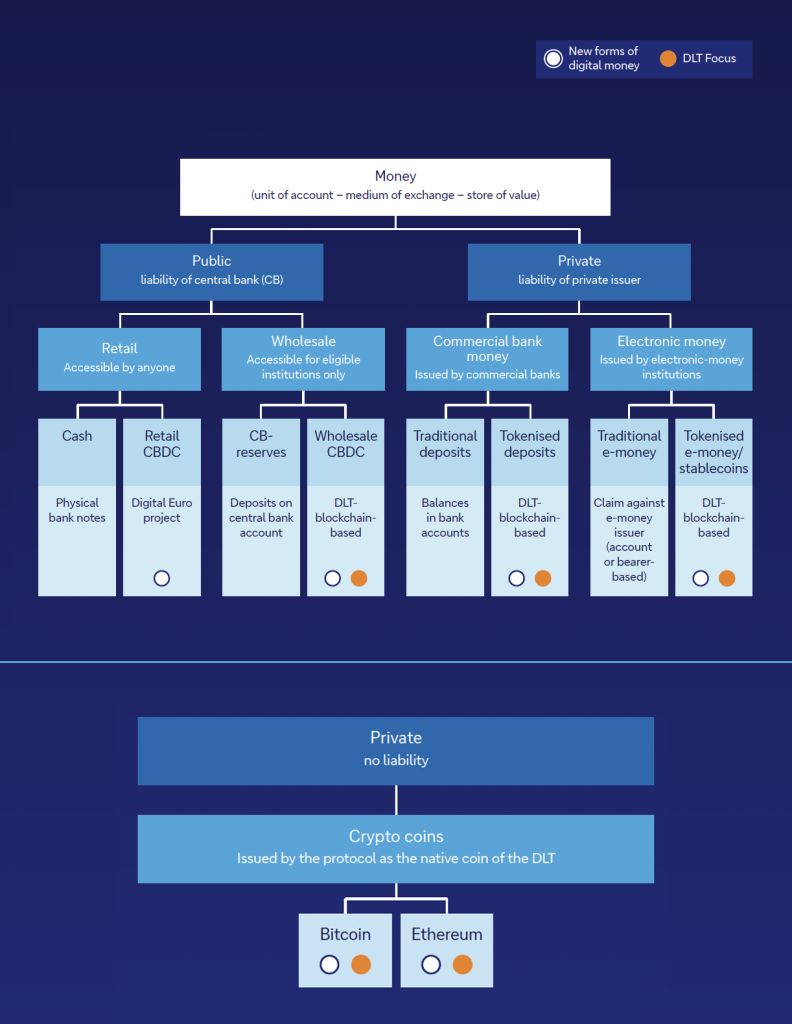
To assess where digital money may reshape market infrastructure, recognition that it is not a single instrument is important: It is a broad landscape of emerging forms of money with different issuers, liability structures, access models and use cases.
There are four different forms of digital money that are issued by the public sector, i.e., the central bank (retail and wholesale Central Bank Digital Currency – CBDC) or the private sector, i.e., commercial banks (tokenized deposits) or electronic money institutions (Stablecoins / e-money tokens).
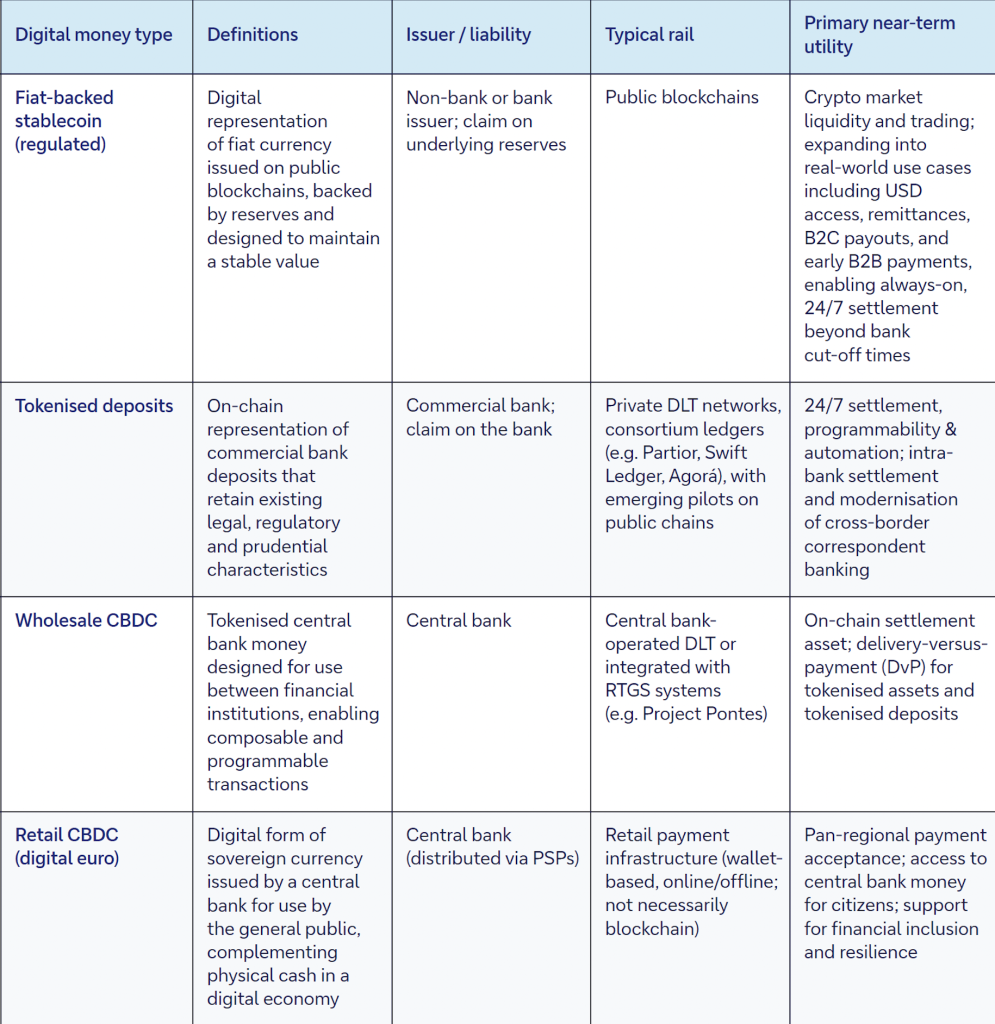
Stablecoins currently receive lots of media and industry attention. They are bearer instrument tokens issued on public blockchain rails, backed by cash reserves or eligible securities, enable crypto use cases where a stable currency is required and are expected to provide more efficient cross border payments. The second form of private digital money is tokenized deposits. These extend commercial bank money into programmable environments while preserving the legal, regulatory and prudential characteristics of bank deposits.
Representing the public-money dimension, wholesale CBDCs represent tokenized central bank money for eligible financial institutions, particularly in interbank settlement and marketinfrastructure contexts. Retail CBDCs, such as the digital euro, are designed for the general public and not as an interbank or business to business settlement rail. Cryptocurrencies sit outside this discussion completely since, without regulated issuers or fiat backing, their value is volatile and primarily speculative.
SCALING
The key question is no longer what digital money is, but whether these emerging forms of money can scale beyond pilots and niche applications. Increasing regulatory clarity and a growing number of market initiatives are helping to move the topic from concept towards implementation.
Regulatory progress is particularly visible in stablecoins. For instance, in the United States, the GENIUS Act introduces a stablecoin-specific framework, including reserve-backing requirements and restrictions on issuer yield generation.
In the European Union, MiCAR embeds stablecoins and other crypto-assets into a broader rules-based framework designed to safeguard financial stability and monetary sovereignty. Across Asia, jurisdictions such as Hong Kong, Singapore, Japan and Thailand are also advancing stablecoin frameworks, reflecting different market structures and policy priorities.
Source: Deutsche Bank: Digital Money – a perspective on stablecoins, tokenised deposits, and CBDCs
https://flow.db.com/publications/flow-white-papers-and-guides/digital-money-a-perspective-on-stablecoins-tokenised-deposits-and-cbdcs
Beyond regulatory progress, infrastructure for tokenized deposits is also becoming more developed. Partior, a blockchain-based settlement network backed by major financial institutions, is already live for real-time cross-border settlement of tokenized deposits, using pre-validation and atomic settlement to reduce breaks and investigations.
Project Agorá brings together seven central banks and more than 40 banks and private enterprises to explore a unified ledger on which tokenized deposits can interoperate with wholesale CBDC for policy-aware, atomic cross-border settlement. Further, Swift’s shared-ledger initiative, together with wholesale CBDC initiatives such as Pontes and Appia, shows how regulated infrastructure and central bank money settlement may extend into programmable environments.
Despite this progress, stablecoin adoption provides an important practical indication of where digital money stands today. Stablecoin volume in 2025 was estimated at US$62trn. Once non-economic activity such as bots and internal transactions is removed, around USD $4.2trn is estimated to represent actual transfers.
Of that amount, roughly US$350bn– USD $550bn corresponded to realeconomy payments, representing less than 1% of the overall stablecoin volume. This is an important reminder that transaction volume and real-world adoption are not the same. Stablecoins are gaining attention for USD access, remittances, B2C payouts, emerging B2B cross-border payments and potential settlement use in tokenized capital markets, but institutional adoption remains at an early stage – albeit strongly growing.
The central conditions for scale are therefore less about whether technology can work in principle and more about whether it can be embedded safely into institutional operating models. Digital money rails must interoperate across platforms, operate under shared governance and compliance standards, support reliable liquidity management, align with messaging frameworks and integrate into existing banking, treasury and control processes.
For institutional use, this also means custody, on- and off-ramping, reconciliation, reporting, ERP and treasury management system integration, and standardized payment information comparable to ISO20022. No single market participant can solve these challenges independently. Success will depend on coordinated industry action, common rulebooks, interoperable technical standards and deeper integration into banks’ messaging, booking, liquidity, control and compliance processes.
Against this background, tokenized deposits may be particularly relevant because they offer a bank-native route to digital settlement. They extend commercial bank money into digital environments while preserving the role of deposits and building on existing legal, regulatory and banking foundations. In principle, they can support 24/7 settlement, automated treasury processes, next-generation correspondent banking and wholesale settlement use cases.
Source: Deutsche Bank: Digital Money – a perspective on stablecoins, tokenised deposits, and CBDCs
https://flow.db.com/publications/flow-white-papers-and-guides/digital-money-a-perspective-on-stablecoins-tokenised-deposits-and-cbdcs
In multi-bank settings, they could enable pre-screening, atomic execution and reduced reconciliation or investigation needs. In tokenized asset markets, they may also provide the cash leg for delivery-versuspayment settlement. Broad deployment, however, depends on shared rulebooks, credible settlement assets, multi-bank interoperability, core banking integration and coordination between real-time onchain updates and settlement finality in RTGS or wholesale CBDC systems.
CBDCs add to the public-money dimension. Retail CBDCs are primarily public payment instruments. Under current digital euro proposals, corporates would not be able to hold digital euros directly; payments would instead settle into bank deposits through an automated defunding mechanism. Their relevance for corporates may therefore be linked more to payment acceptance than to deep treasury transformation in the near term. Wholesale CBDCs, by contrast, are increasingly relevant to financial market infrastructure. They may support interbank settlement, tokenized capital markets, delivery-versus-payment and payment-versus-payment use cases, especially where settlement finality in central bank money is required.
PRACTICAL RELEVANCE
The practical relevance of each form of money will depend on the use case it is meant to serve. Stablecoins may serve selected capital-markets and crossborder flows where they improve speed, transparency or access to currency liquidity, provided they are integrated into settlement, control, compliance and liquidity processes.
Tokenized deposits can underpin nextgeneration correspondent banking and support 24/7 value transfer, while wholesale CBDC can provide central bank money settlement on blockchain rails and the missing settlement asset for interbank transfers – also in tokenized deposits.
In more advanced use cases, these rails may also support more dynamic intraday liquidity and FX management, particularly where payment-versuspayment settlement and 24/7 settlement assets become operationally reliable. In the euro area, however, limitations remain, including the current lack of on-chain settlement finality and 24/7 capability for a EUR wholesale CBDC token – which the Pontes Project of the Eurosystem will tackle already in Q1 2028.

COMING TOGETHER
But how do these four forms of digital money come together? The likely end state is not one model replacing all others, but an ecosystem in which stablecoins, tokenised deposits and CBDCs serve different needs within an increasingly connected financial system.
Banks are likely to play an important role in abstracting this complexity for clients. From a client perspective, the central question is not whether a transaction uses a stablecoins, tokenized deposit or CBDC, but whether the payment, liquidity or settlement outcome becomes safer, more efficient, more transparent and better integrated. Digital money is therefore not an isolated technology trend, but part of a broader transition towards 24/7-capable, interoperable and more responsive financial infrastructure.