
From uncertainty to opportunity: Building the regulatory foundations for digital money
Christian Schmid, Senior Partner and Global Leader, Head Global Banking & CIB and Assia Gardiner, Partner & Associate Director, Digital Asset Risk Management and Regulation at Boston Consulting Group.

Regulation of digital money is moving rapidly from first principles into concrete frameworks. Yet maturity and regulatory treatment still vary materially across instruments and jurisdictions. As institutional adoption grows, the task is no longer simply to decide whether a token may be issued. It is to ensure that the monetary claim remains intact through holding, transfer and settlement, and that different forms of digital money can coexist without fragmenting money itself.
This is why regulation is becoming part of the operating infrastructure of digital money. Just as payment rails determine how value moves, legal and regulatory frameworks determine what a token represents, who is responsible for it, when a transfer becomes final and whether different forms of money can exchange at par. Well-designed rules do not remove every risk. They make risks legible, assign responsibility and give institutions confidence to commit capital and move beyond pilots.
START WITH THE MONETARY CLAIM
The defining feature of any form of digital money is not the technology used to represent it, but the monetary claim behind it:
- Regulated fiat-referenced stablecoins rely on reserve backing and enforceable redemption rights.
- Tokenised deposits remain liabilities of commercial banks.
- Central bank money is a direct claim on the central bank. The technology may look similar, but the economic meaning and safeguards are different. Regulation establishes the link between token and claim through different routes:
- Stablecoin regimes increasingly address authorisation, reserve quality, governance, holder rights and redemption.
- Tokenised deposits generally remain within the banking framework where tokenisation leaves the underlying deposit claim unchanged, although classification becomes more consequential as designs become transferable and the boundary with other regulated forms of digital money narrows. The European Banking Authority has concluded that tokenisation does not in itself change the fundamental nature of a deposit, while calling for greater convergence in distinguishing tokenised deposits from electronic money tokens.
- For central bank money, the claim itself is not in doubt. The central questions are access, distribution and the infrastructure through which it is used. This is not taxonomy for its own sake. Classification determines insolvency treatment, prudential exposure, liquidity management and whether institutions can confidently use the instrument.
PROTECT INTEGRITY THROUGH THE LIFECYCLE
Issuance is only the starting point. Digital money must remain aligned with its underlying claim as it is held, transferred across networks, settled and ultimately redeemed.
Three tests matter.
First is claim-to-token alignment: the outstanding token must continue to match the legal and financial position behind it. For stablecoins, this includes consistency between reserves and token supply.
Second is cross-network integrity: where the same claim is represented on another network, minting and burning arrangements must preserve aggregate supply and prevent duplicate claims.
Third is legal finality: completion on a ledger must correspond to the point at which ownership legally transfers, and the underlying obligation is discharged.
Integrity exists only when legal, financial and technical records continue to describe the same economic reality. That requires a clear allocation of responsibility across issuers, intermediaries, custodians and infrastructure providers. Law and supervision matter, as do contracts, technical standards and market controls. CPMI and IOSCO already apply established financial-market-infrastructure principles to systemically important stablecoin arrangements, including governance, comprehensive risk management, settlement finality and money settlement.
Clear responsibility also changes the economics of adoption. It reduces duplicated controls, repeated legal analysis and bespoke operating models. That is what allows firms to industrialise infrastructure rather than merely demonstrate that the technology works.
FROM RELIABLE INSTRUMENTS TO ONE MONETARY SYSTEM
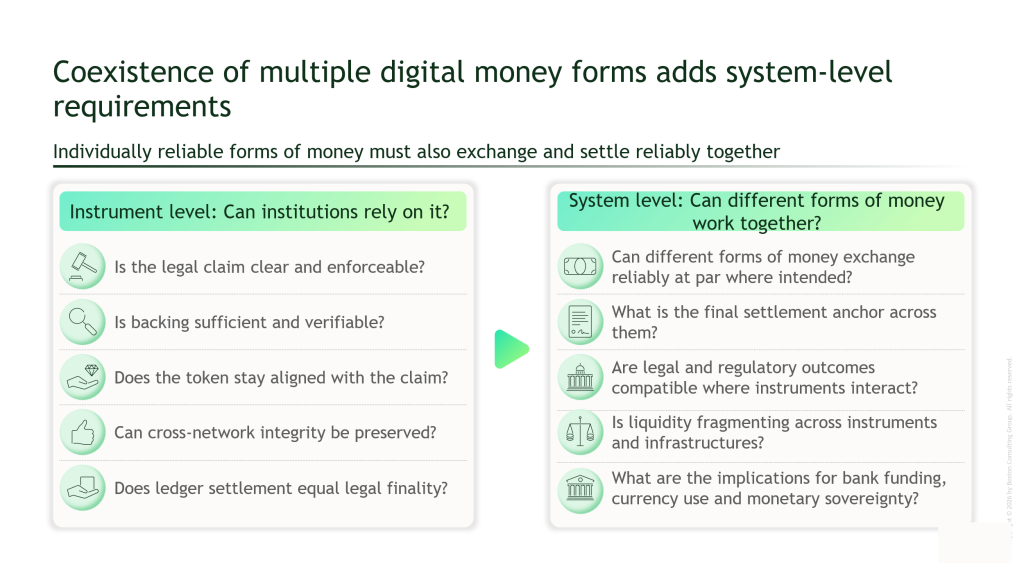
Even individually sound instruments are not enough. As stablecoins, tokenised deposits and central bank money coexist, the question changes from “Can institutions rely on it?” to “Can different forms of money work together?”
They need to exchange at par where intended, operate under compatible legal and regulatory arrangements and settle against a clear final anchor. Persistent differences in value or treatment can fragment liquidity across instruments and infrastructures. Transfers involving several forms of money must produce a consistent legal answer on ownership and discharge.
Wider adoption can affect the monetary system itself. Currency denomination and the location of liquidity and reserves can influence bank funding, currency reach and monetary sovereignty. These are systemlevel questions, distinct from the reliability of any single instrument.
FOUR REGULATORY FOUNDATIONS FOR SCALE
The remaining agenda can be organised around four foundations.
First, define the claim and the regulatory perimeter. For stablecoins, the focus is moving beyond issuance and reserves towards liquidity under stress, recovery and resolution. For tokenised deposits, authorities need a consistent view of where the deposit perimeter ends as instruments become transferable and interoperable.
Second, preserve integrity throughout the lifecycle. Responsibilities must remain clear when issuance, custody, transfer and settlement involve different entities. Regulation should establish the required outcomes while allowing contracts, standards and technology to evolve.
Third, make interaction reliable. Tokenised markets need practical access to a trusted settlement asset and arrangements that connect different ledgers without sacrificing finality. The Eurosystem is pursuing this through Pontes, designed to link market DLT platforms to TARGET Services, alongside the longer-term Appia initiative. Project Agorá has demonstrated atomic multicurrency settlement using tokenised commercial bank deposits and central bank reserves while preserving their legal character. The next challenge is translating such prototypes into scalable technical, operational and contractual arrangements.
Fourth, manage cross-border and system-level effects. Divergent reserve, redemption and issuer rules can make a single operating model difficult across major markets. As adoption begins to affect bank funding, liquidity or monetary sovereignty, instrument-level safeguards may need to be supplemented by proportionate measures aimed at the wider system.
These foundations will not make every use case succeed, but they change the investment equation. Institutions can build reusable capabilities rather than countryby- country workarounds; liquidity can form across compatible infrastructures; and automation can extend into settlement, servicing and cross-border payments.
Digital money will make the architecture of money more diverse. The objective should not be to make every form of digital money identical, but to ensure that many forms can still function as one monetary system. When claims are clear, integrity is preserved and settlement is final, regulation stops being a barrier around digital money and becomes the infrastructure on which it can scale.